
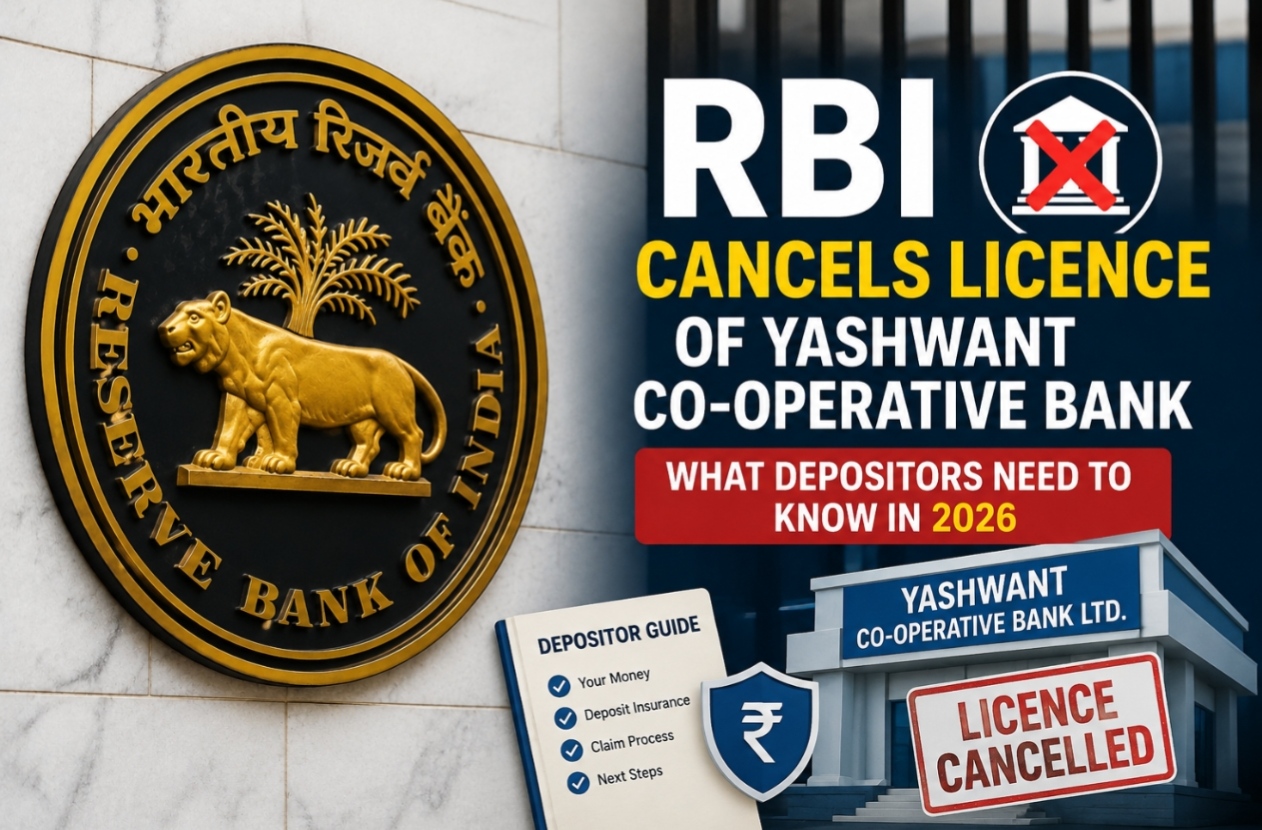
The Reserve Bank of India (RBI) has cancelled the banking licence of Yashwant Co-operative Bank. Depositors naturally want to know whether their money is safe and what they should do next. This article explains, in plain language, why RBI takes such action, what happens to deposits, how the Rs. 5 lakh deposit insurance works, and the steps depositors should follow.
Why Does RBI Cancel a Bank’s Licence?
RBI regulates banks in India. One of its main jobs is to make sure banks are financially sound and follow the rules that protect depositors. When a bank is found to be in serious trouble, RBI can cancel its licence. In this case, RBI found that the bank did not have adequate capital, could not continue safe banking operations, and was failing to comply with important banking regulations. When a bank cannot pay its depositors in full, allowing it to continue operating puts them at greater risk. A cancellation usually follows supervision, inspections and warnings. RBI steps in when it concludes the bank cannot be revived.
What Happens to the Bank After the Licence Is Cancelled?
Once the licence is cancelled, the bank can no longer carry on banking business: no fresh deposits, no new loans, no normal banking transactions. The bank then goes into winding up, also called liquidation. A liquidator sells its assets, recovers its loans and settles its dues. Depositors are paid from the money recovered, and from deposit insurance where it applies. A cancelled licence does not mean the money has disappeared: the bank’s assets still exist and are used to repay depositors as far as possible.
Is Depositors’ Money Safe? The DICGC Cover of Rs. 5 Lakh
In India, deposits are protected by insurance from the Deposit Insurance and Credit Guarantee Corporation (DICGC), a wholly owned subsidiary of RBI. This protection applies to co-operative banks as well as commercial banks. Under DICGC rules, each depositor is insured up to Rs. 5 lakh. This covers all deposits held by a person in the same bank, in the same capacity and in the same right, including savings, current, fixed and recurring deposits, plus interest due, up to the limit. For example, a savings balance of Rs. 2 lakh plus a fixed deposit of Rs. 4 lakh totals Rs. 6 lakh, but the cover is capped at Rs. 5 lakh. If the total is Rs. 3 lakh, the full amount is covered.
How Do DICGC Claims Work?
When a bank’s licence is cancelled and it is ordered to be wound up, the DICGC process begins. The liquidator prepares a list of depositors and the amounts owed, and submits the claim to DICGC. DICGC verifies the claim and pays the insured amount to the liquidator, who distributes it to depositors. The law also provides for faster payment of deposit insurance where a bank faces restrictions, even before liquidation is complete. The timeline depends on how quickly the depositor list is verified. Keep documents ready and respond promptly to the liquidator. Never pay anyone who promises to speed up your claim for a fee.
What Depositors Should Do Step by Step
- Keep all bank documents safe. Gather your passbook, fixed deposit receipts, account statements and KYC documents. These prove your deposits and will be needed for the claim.
- Follow only official updates. Trust only notices from RBI, the DICGC or the bank’s liquidator. Avoid rumours on social media: false messages about refund dates are common.
- Do not panic or rush. The insurance system exists for exactly this situation, and deposits up to Rs. 5 lakh are protected. Rushing to the branch will not speed up payment.
- Keep your contact details updated. The liquidator will use the address, phone number and email recorded with the bank. If you have moved or changed your number, inform the liquidator.
- Plan your finances in the meantime. Review your monthly expenses and other accounts. Funds in other banks will ease the pressure while the claim is processed.
- Be careful of fraud. Bank failures attract fraudsters. Nobody from RBI, DICGC or the bank will call asking for your OTP, PIN or bank details, or demand a fee to release your money.
How to Check If Your Bank Is Safe
This case is a reminder to check the health of any bank where you keep money, especially smaller co-operative banks. First, confirm that the bank is licensed by RBI. Any bank operating without a licence should be avoided entirely. Second, look at the bank’s financial health. Larger banks publish their financial results, capital adequacy ratio and bad loan figures. Third, spread your deposits. The DICGC cover applies per bank, per depositor, so any amount above Rs. 5 lakh in a single small bank is at risk. Splitting deposits across two or more sound banks increases your total cover. Fourth, be cautious about unusually high interest rates: a bank offering rates far above others may be taking greater risks.
Are Co-operative Banks Safe?
Many co-operative banks in India are well run and serve their communities effectively, especially in small towns and rural areas. They provide credit to farmers, small traders and local businesses that larger banks sometimes overlook. However, smaller banks can carry higher risk, because they have less capital, fewer branches and a loan book concentrated in one region. Depositors should choose carefully, keep the Rs. 5 lakh insurance limit in mind, and not put all their savings in one small institution.
Frequently Asked Questions
What happens to my fixed deposit? It is part of your total deposits, covered by DICGC insurance up to Rs. 5 lakh. The claim is settled through the liquidator and DICGC.
I have more than Rs. 5 lakh. Will I lose the rest? Amounts above Rs. 5 lakh are not covered. Recovery of the excess depends on what the liquidator recovers from the bank’s assets.
Can I still withdraw money? No. After the licence is cancelled, branch and ATM withdrawals stop. Payments are made through the DICGC and liquidation process.
How long will it take to get my money back? There is no fixed date. It depends on how quickly the liquidator verifies the depositor list. Follow official notices for updates.
Does DICGC cover all banks? DICGC covers commercial banks, regional rural banks, local area banks and licensed co-operative banks. It does not cover non-banking finance companies or unlicensed institutions.
Conclusion
The cancellation of the bank’s licence is difficult news for its depositors, but the deposit insurance system provides real protection. Deposits up to Rs. 5 lakh are insured, and the claim process returns that money through official channels. Stay calm, keep documents ready, follow only official notices and guard against fraud. RBI’s action also serves a larger purpose: a weak bank that keeps operating can take more deposits and make more bad loans. For everyone else, the episode is a reminder to check where your money is kept and understand the Rs. 5 lakh insurance limit.
Yashwant Co-operative Bank: What Depositors Must Remember
The Yashwant Co-operative Bank case is a reminder to check the health of any bank where you keep money. RBI has taken similar action against other lenders — read our report on RBI cancelling 49 NBFC licences to understand how the crackdown works. If you fear fraud around a bank failure, see how to stay safe from banking fraud. For official updates on Yashwant Co-operative Bank, check the RBI website and the DICGC claim process before trusting any message that asks for your bank details.
2 thoughts on “RBI Cancels Licence of Yashwant Co-operative Bank – What Depositors Should Know in 2026”