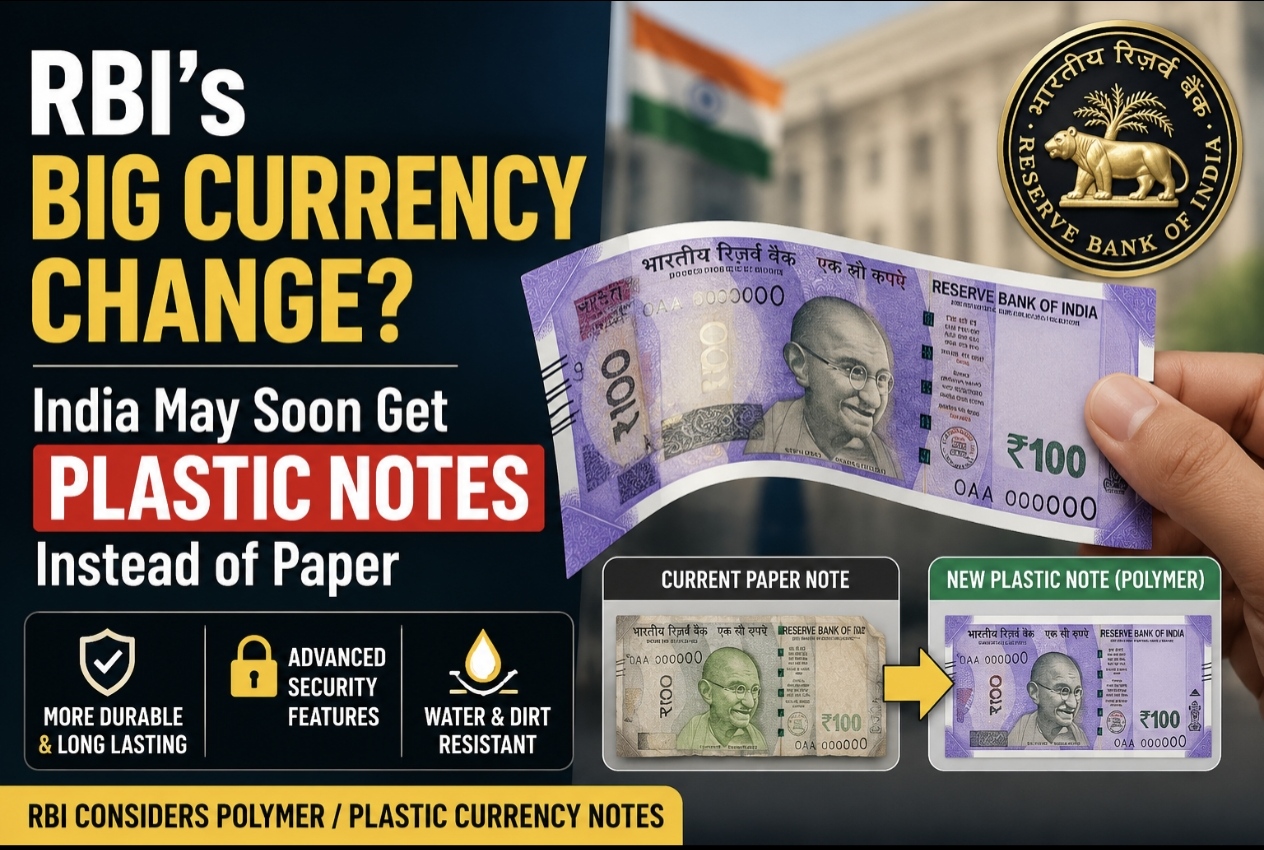
Reports that the Reserve Bank of India (RBI) is studying plastic currency notes have raised a simple question: will the old paper notes in our wallets be closed? The short answer is no. RBI has studied polymer notes, but it has not discontinued any existing currency notes, and no official announcement says old notes will stop being valid. This guide explains what plastic notes are, why RBI has considered them, and what they would mean for ordinary users.
What Are Plastic Currency Notes?
Plastic currency notes, also called polymer banknotes, are made from a special polymer material rather than cotton-based paper. The polymer is designed specifically for banknotes. Several countries already use polymer notes, including Australia, Canada, New Zealand, Singapore and the United Kingdom. Australia was among the first to adopt them. There, polymer notes have generally lasted longer and proved harder to counterfeit.
Why Has RBI Considered Plastic Notes?
RBI’s interest in polymer notes is not new. The central bank has examined the idea at different times, because currency management is one of its major responsibilities. India has billions of notes in circulation, and keeping them clean, usable and secure is a large and expensive task. One reason is durability. Paper notes tear, get dirty and fade after passing through many hands. A damaged note may be refused by a shopkeeper or rejected by an ATM. Polymer notes resist tearing, moisture and dirt much better, so they stay in circulation longer, and fewer replacements need to be printed, which can reduce costs over time. Another reason is security. Counterfeit currency remains a concern for every central bank. Polymer notes can carry features that are difficult to reproduce, such as transparent windows, advanced holograms, colour-changing elements, micro-text printing and special security threads, making fake notes harder to produce and easier to identify. Polymer notes also stay cleaner for longer, a practical benefit where cash is widely used in markets, transport and small shops.
The Current Status: What RBI Has and Has Not Said
Separate reports from official announcements. Media reports have said at various times that RBI is exploring polymer notes, possibly starting with a pilot in selected denominations. However, RBI has not announced a launch date, and it has not said that paper notes will be withdrawn. This distinction matters, because currency changes in India are often surrounded by rumours. A study or a pilot project is not the same as a decision to replace all notes. If RBI does move ahead, it would introduce new notes gradually, alongside the existing ones, giving the public plenty of time to adjust.
Will Old Notes Be Closed?
There is no official basis for the claim that old notes are being closed. Your current notes in denominations of ten, twenty, fifty, one hundred, two hundred and five hundred rupees remain valid legal tender. If polymer notes are introduced, new and old notes would most likely circulate together for a considerable period. This is how currency transitions normally work: a central bank does not suddenly invalidate the cash in people’s pockets, because that would disrupt daily life, trade and banking. Any change of that scale would be announced well in advance, with clear instructions from RBI. For now, keep using your existing notes as normal, and rely only on announcements from RBI or your bank rather than on social media forwards claiming that notes are about to be banned.
What Would Change for Ordinary Users?
If polymer notes do arrive, the practical effect on daily life would be small. A polymer note works exactly like a paper note: it is accepted in shops, deposited in banks and dispensed by ATMs. The main difference is that the notes feel different, last longer, and survive accidents such as being left in a pocket during a wash. Polymer notes can be slippery when new, so counting a stack of them may feel different at first. They can also be damaged by very high heat, so they should not be ironed or left near a hot surface. In general, though, they are designed to be tougher than paper notes in everyday use. Shopkeepers and small traders would benefit most, because they would receive fewer torn or dirty notes.
Lessons from Other Countries
Australia introduced polymer notes in the late 1980s and later moved its entire currency to polymer. Canada completed its switch in 2013, and the United Kingdom began issuing polymer notes in 2016. In each case, the transition was gradual: new notes were introduced one denomination at a time, old paper notes were withdrawn over a long period, and the public was given clear guidance. India would be expected to follow a similar approach. Counterfeiting rates in these countries have generally fallen after the switch, because the material is harder for counterfeiters to obtain and the security features are difficult to copy.
How to Spot a Fake Note
Whether notes are paper or polymer, knowing how to check them is useful. RBI’s official guidance on the Mahatma Gandhi series lists several features to verify, including the watermark, the security thread, the latent image, the micro-lettering and the colour-changing ink on higher denominations. A simple habit is to look, feel and tilt: look at the note in the light for the watermark and security thread, feel the raised print on the portrait and the identification mark, and tilt the note to see the colour-changing ink. If a note looks suspicious, do not try to pass it on. Take it to your bank for examination.
Frequently Asked Questions
Are plastic currency notes already in use in India? No. India uses paper-based banknotes. RBI has studied polymer notes, but it has not launched them for general circulation.
Will my old notes become invalid if plastic notes are introduced? No announcement says so. If polymer notes are introduced, old notes would be expected to remain valid.
Which denomination would come first? RBI has not announced any denomination. In other countries, the switch usually began with lower denominations, but there is no confirmed plan for India.
Are polymer notes more expensive to print? Polymer notes generally cost more to produce per note, but they last much longer, so the overall cost over the life of the note can be lower.
How can I stay updated? Follow announcements on RBI’s official website and press releases, and check notices from your bank. Avoid forwarded messages that claim a currency change without citing an official source.
Conclusion
Plastic currency notes are a genuine subject of study at RBI, and other countries’ experience suggests real benefits: longer-lasting notes, better security and lower replacement costs. But the idea is still at the stage of study and discussion, not a decision to withdraw existing notes. For ordinary users, the message is reassuring: your current notes are valid, there is no deadline to exchange them, and any future change would be announced officially and introduced gradually. Until then, handle your notes carefully, learn the basic security features, and treat rumours about currency bans with caution.
RBI Plastic Currency Notes: Key Points
RBI plastic currency notes are polymer banknotes that last longer, resist dirt and water, and are harder to counterfeit than paper notes. RBI has studied polymer notes for years, but as of 2026 there is no announcement that old notes will be closed or replaced. If plastic notes are introduced, your current notes will remain valid — do not believe rumours about old notes becoming worthless. Read the related cases of RBI cancelling Yashwant Co-operative Bank’s licence and RBI cancelling 49 NBFC licences to see how the regulator acts. For official announcements on currency, check the RBI website. RBI plastic currency notes would be a gradual change, not a sudden currency ban.