
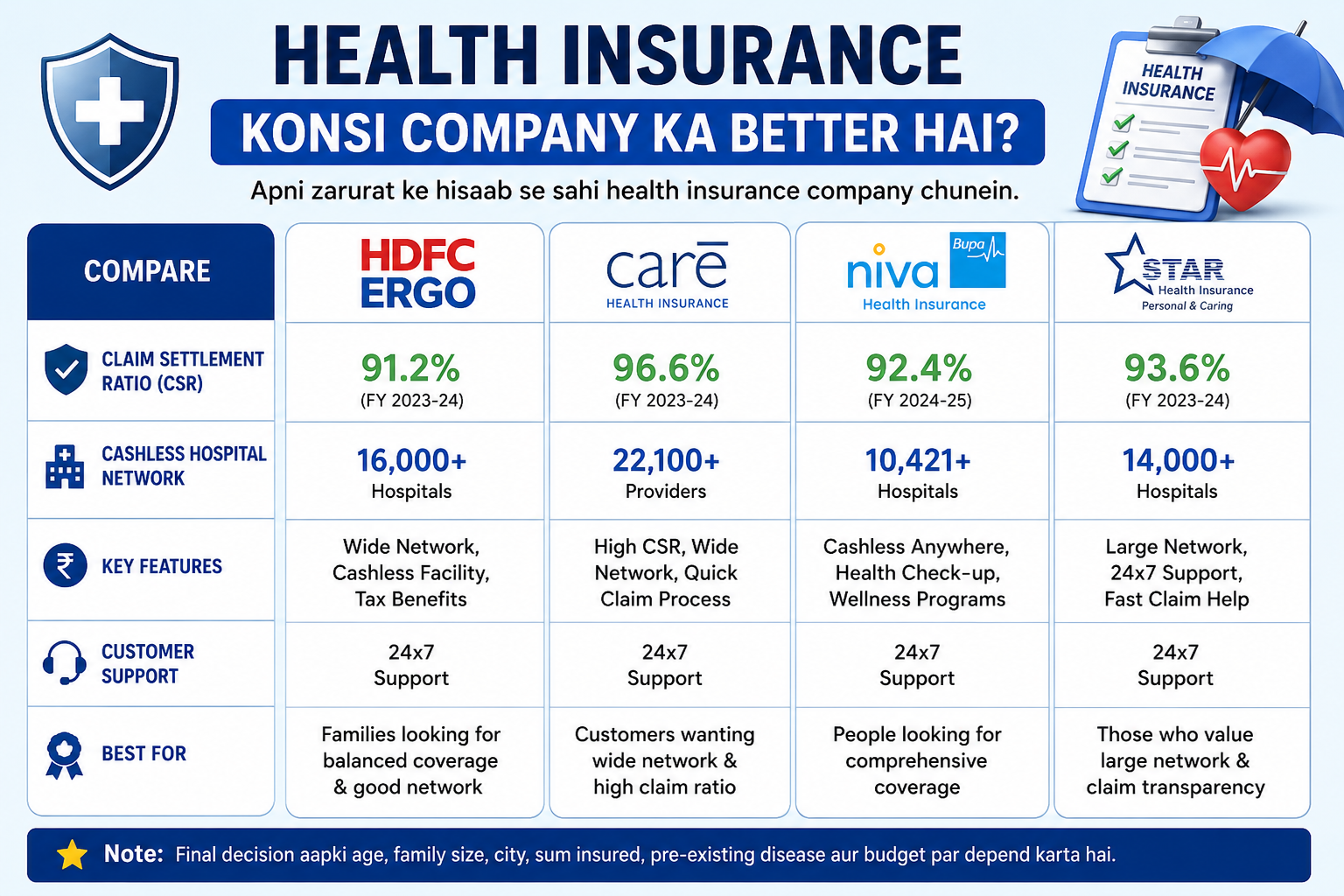
Which health insurance company is best? It is the first question almost everyone asks after deciding to buy health insurance — and it is also the wrong question. No single company is best for everyone. The best health insurance company for you depends on your age, your city, your family size, your medical history and your budget. This guide explains how to judge a company on facts instead of advertisements, so you can choose the right one with confidence.
Why There Is No Single “Best” Company
A company with a large hospital network in Delhi may have very few network hospitals in a smaller town. A plan that is affordable for a healthy 30-year-old may be expensive for a 55-year-old with diabetes. A policy that covers maternity may be useless for a single person, and a policy with a low premium may hide a co-payment clause that makes you pay 20 percent of every bill. Instead of chasing a brand name, compare companies on the five factors below.
1. Claim Settlement Ratio (CSR)
The claim settlement ratio tells you what percentage of the claims a company received were settled. A ratio above 95 percent is generally considered good, and you should also check how quickly claims are settled and what share are settled within three months. The Insurance Regulatory and Development Authority of India (IRDAI) publishes insurer-wise claim data in its annual report, and insurers publish the same figures in their public disclosures — check the latest figures there rather than trusting a number in an advertisement.
Also look at the claim repudiation ratio, which shows how many claims were rejected. A company can have a high settlement ratio and still be slow, so read both numbers together before deciding.
2. Network Hospitals and Cashless Treatment
Cashless treatment means the insurer settles the hospital bill directly, so you do not have to arrange lakhs of rupees first and claim them back later. Before buying, check that the insurer has network hospitals near your home — especially for emergencies, when you cannot travel far. A company with 10,000 network hospitals across India is of little use if none of them is in your town. Also check whether the hospitals you would actually use, including multi-speciality hospitals in your city, are on the list.
3. Coverage, Waiting Periods and Exclusions
Read the policy wording, not just the brochure. The details that matter most are the waiting period for pre-existing diseases (usually two to four years), the waiting period for specific diseases and procedures, room rent limits, co-payment clauses, sub-limits on surgeries, day-care coverage, and pre- and post-hospitalisation cover (commonly 30 and 60 days). Useful add-ons include a restore benefit, which refills your sum insured if it is used up in a year, and a no-claim bonus, which increases your cover for every claim-free year.
4. Premium vs Value
The cheapest premium is rarely the best deal. Compare plans at the same sum insured and for the same family composition, and check what you give up for the lower price — a room rent cap, a co-payment clause, or a smaller hospital network. For a family of four in a metro city, a 5 lakh rupee cover is a reasonable starting point, and a super top-up plan can add a much larger cover at a relatively low extra cost. Remember that premiums rise with age, so a plan that looks cheap at 30 may become expensive at 50.
5. Customer Service and the Claim Process
Good service matters most when you are in a hospital. Check whether the company offers a 24×7 helpline, in-house claim settlement or a third-party administrator (TPA), online claim tracking, and a clear grievance redressal process. Read recent customer reviews about claim experiences, not just about buying the policy. A smooth buying experience means nothing if the claim process is painful.
How to Compare Companies in 5 Steps
- Decide your sum insured first — 5 to 10 lakh rupees for a small family, more in metro cities.
- Shortlist three or four companies with a strong claim settlement ratio and network hospitals near you.
- Read the policy wording of each — waiting periods, exclusions, co-payment and room rent rules.
- Compare premiums for the same sum insured and the same family members.
- Check the insurer’s solvency ratio. IRDAI requires a minimum of 1.5, and a higher ratio indicates stronger financial health.
Individual Plan, Family Floater or Super Top-Up?
A family floater covers the whole family under one sum insured and is usually cheaper than separate individual plans for each member. It works well for young families, but it is not ideal when one member is much older or has a serious illness, because that member’s claims consume the shared cover. In that case, a separate plan for the older member plus a floater for the rest is often better. A super top-up plan is a low-cost way to increase total cover: it pays only after your base plan’s deductible is crossed, so a 5 lakh base plan plus a 20 lakh super top-up can give 25 lakh of cover at a fraction of the cost of a single 25 lakh plan.
Common Mistakes to Avoid
- Buying only to save tax — protection comes first, tax saving is a bonus.
- Hiding your medical history — undisclosed illness is the most common reason claims are rejected.
- Choosing too small a sum insured — medical inflation in India is high, and a 3 lakh cover is often exhausted by one hospitalisation.
- Ignoring the waiting period for pre-existing diseases — buy early so the waiting period ends before you need the cover.
- Not informing the insurer about a claim on time — most policies require intimation within 24 to 48 hours of hospitalisation.
Frequently Asked Questions (FAQ)
Q1: Which health insurance company has the highest claim settlement ratio?
The ranking changes every year. Check the latest IRDAI annual report or the insurer’s public disclosures for the most recent figures. A ratio above 95 percent is a good sign, but also check how fast claims are settled.
Q2: Is a higher premium always better?
No. A higher premium usually means more cover or a wider network, but it can also mean you are paying for features you do not need. Compare coverage, waiting periods and exclusions at the same sum insured before deciding.
Q3: Can I port my health insurance to another company?
Yes. Health insurance portability allows you to switch insurers while carrying over the waiting period credit you have already served. Apply at least 45 days before your renewal date.
Q4: What is a super top-up plan?
A super top-up plan provides additional cover above a deductible. For example, with a 5 lakh base plan and a 20 lakh super top-up with a 5 lakh deductible, claims above 5 lakh are covered by the top-up, giving you 25 lakh of total cover at a much lower premium than a single 25 lakh policy.
Also read: लाइफ इंश्योरेंस vs हेल्थ इंश्योरेंस: कौन बेहतर है? पूरी गाइड हिंदी में — a complete Hindi guide to choosing between life and health insurance.
Conclusion
There is no universal best health insurance company — there is only the best company for your situation. Compare claim settlement ratios, network hospitals, waiting periods, exclusions and premiums, and read the policy wording before you pay. The right policy is not the cheapest one or the most advertised one; it is the one that pays your claim smoothly when you need it most. Buy early, disclose your medical history honestly, and review your cover every two to three years as your family and income grow.
Best Health Insurance Company: Quick Checklist
Before you finalise the best health insurance company for your family, use this quick checklist: compare the claim settlement ratio of at least three insurers, check the network hospitals near your home, read the waiting-period clause for pre-existing diseases, and confirm the premium fits your budget for the next 10–15 years. Also read our guide on best health insurance plans in India 2026 to compare plans side by side, and our best term insurance plans in India 2026 guide if you also need life cover. For official claim and grievance rules, check the regulator IRDAI. The best health insurance company for you is the one that pays claims smoothly and covers your family’s real needs.


2 thoughts on “Which Health Insurance Company Is Best, and How to Choose the Right One”