
Post office schemes are among the safest ways to save money in India. Backed by the Government of India and available at more than 1.5 lakh post offices across the country, these schemes offer guaranteed returns, tax benefits and simple rules — which is why crores of Indians, from farmers to retired government employees, trust them with their savings. In this guide, we explain the main post office schemes, who each one is for, and how to choose the right one in 2026.
Why Post Office Schemes Are Popular
Unlike the stock market or mutual funds, post office schemes do not depend on market performance — the returns are fixed and guaranteed by the government. There is no risk of losing your principal, the schemes are available even in small towns and villages where banks may not have branches, and most of them offer tax deductions under Section 80C. For people who want safety first, they remain hard to beat.
One important thing to remember: interest rates on small savings schemes are revised by the government every three months. The rates you read in an old article may be out of date, so always check the current rate on the India Post website (indiapost.gov.in) or at your nearest post office before investing.
1. Public Provident Fund (PPF)
PPF is the most popular long-term savings scheme in India. You can open an account with as little as Rs. 500 a year and deposit up to Rs. 1.5 lakh a year. The account runs for 15 years and can be extended in blocks of five years. PPF has the rare EEE tax status — the deposit, the interest and the maturity amount are all tax-free. It is the best option for building a tax-free retirement corpus slowly and safely.
2. National Savings Certificate (NSC)
NSC is a five-year fixed deposit scheme available at post offices. You invest a lump sum, and the interest is compounded and paid at maturity. Deposits qualify for a tax deduction under Section 80C, and the interest earned is reinvested for tax purposes in the first four years. NSC suits people who have a lump sum and want a safe five-year investment with a tax benefit.
3. Senior Citizens Savings Scheme (SCSS)
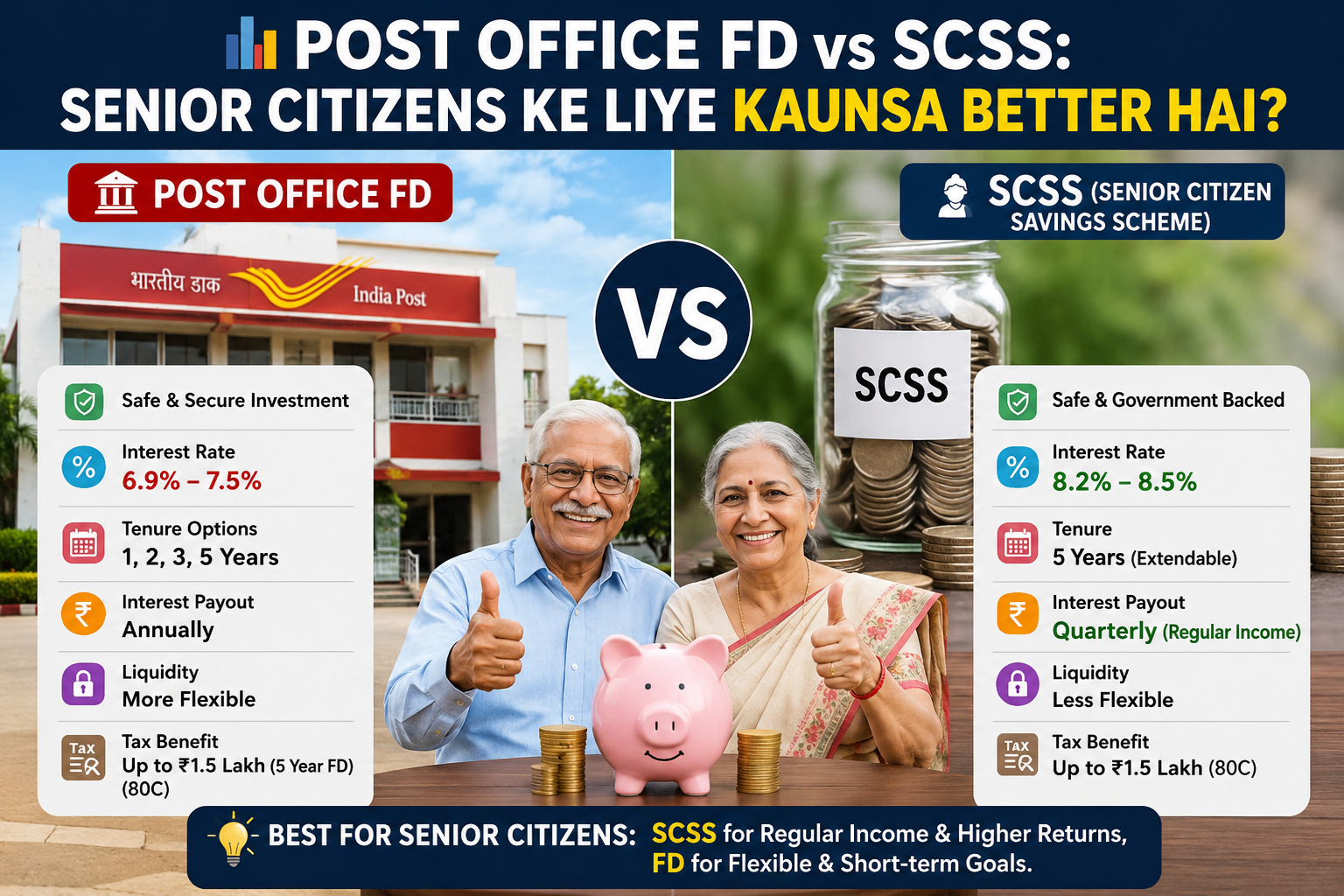
SCSS is designed for people aged 60 and above (and 55+ in some retirement cases). It pays interest every three months, which makes it ideal for retirees who need regular income. The account runs for five years and can be extended by three more years. The maximum deposit is Rs. 30 lakh. Interest is taxable, and tax is deducted at source if the interest exceeds the prescribed limit in a financial year.
4. Post Office Monthly Income Scheme (MIS)
As the name suggests, MIS pays interest every month. You deposit a lump sum and receive a fixed monthly payout, which is useful for households that need a steady monthly income. The account runs for five years. MIS works well for retirees and for people who want a predictable monthly income without touching the principal.
5. Sukanya Samriddhi Yojana (SSY)
SSY is a savings scheme for the girl child, opened by parents or guardians for a girl below the age of 10. Deposits can be as low as Rs. 250 a year and up to Rs. 1.5 lakh a year, and the account matures after 21 years (or at the girl’s marriage after age 18). Like PPF, it enjoys EEE tax status. SSY usually offers the highest interest rate among small savings schemes, which makes it an excellent way to save for a daughter’s education and marriage.
6. Time Deposit and Recurring Deposit
The Post Office Time Deposit works like a bank fixed deposit, with terms of one, two, three and five years — the five-year deposit also qualifies for a Section 80C deduction. The Recurring Deposit (RD) lets you save a fixed amount every month for five years, which suits salaried people who want to build a corpus through small monthly savings.
Which Scheme Is Best for You?
| Your goal | Best scheme |
|---|---|
| Tax-free long-term savings | PPF |
| Safe 5-year investment with tax benefit | NSC or 5-year Time Deposit |
| Regular income after retirement | SCSS or Monthly Income Scheme |
| Saving for a daughter | Sukanya Samriddhi Yojana |
| Small monthly savings | Recurring Deposit |
Important Things to Remember
- Interest rates are revised every quarter — check the current rate before investing.
- Interest on SCSS, MIS and Time Deposits is taxable; PPF and SSY are tax-free at all stages.
- Always add a nominee to your account.
- Premature closure is allowed in most schemes but usually comes with a penalty or a lower rate.
- You can open post office scheme accounts at any post office, and many can now be managed online through India Post Payments Bank and internet banking.
Frequently Asked Questions (FAQ)
Q1: Are post office schemes safe?
Yes. They are backed by the Government of India, and your principal is guaranteed. There is no market risk.
Q2: Can I open more than one post office scheme account?
Yes, you can hold different schemes at the same time — for example, a PPF for retirement and an SSY for your daughter — subject to each scheme’s limits.
Q3: Is the interest on post office schemes taxable?
Interest on PPF and SSY is fully tax-free. Interest on NSC, SCSS, MIS, Time Deposit and RD is taxable as per your income tax slab.
Q4: Post office FD or bank FD — which is better?
Both are safe. Compare the current interest rates, check whether the deposit is covered by DICGC insurance (bank deposits up to Rs. 5 lakh are insured), and consider the tax benefit of the five-year post office Time Deposit under Section 80C.
Also read: Post Office FD vs SCSS: Senior Citizens Ke Liye Kaunsa Better Hai?
Conclusion
Post office schemes remain one of the most reliable ways for Indian families to save. PPF and Sukanya Samriddhi Yojana are the best choices for long-term, tax-free saving; SCSS and the Monthly Income Scheme give retirees a regular income; and NSC and Time Deposits suit safe medium-term goals. Pick the scheme that matches your goal, check the current interest rate before investing, and let the safety of a government-backed scheme work for you.
Post Office Schemes: Key Points
Post office schemes are the safest way for Indian families to save — PPF for tax-free long-term growth, NSC for a 5-year tax-saving deposit and SCSS for retirement income. The best post office schemes in 2026 for a young family are PPF and SSY, while senior citizens should look at SCSS first. For a daughter’s future, read our Sukanya Samriddhi Yojana 2026 guide, and compare FD options in post office FD vs SCSS. For official interest rates and scheme rules, check India Post. Pick post office schemes by your goal, not by the highest rate alone.

6 thoughts on “Post Office Schemes 2026: PPF, NSC, SCSS, MIS and Sukanya Samriddhi Explained”