
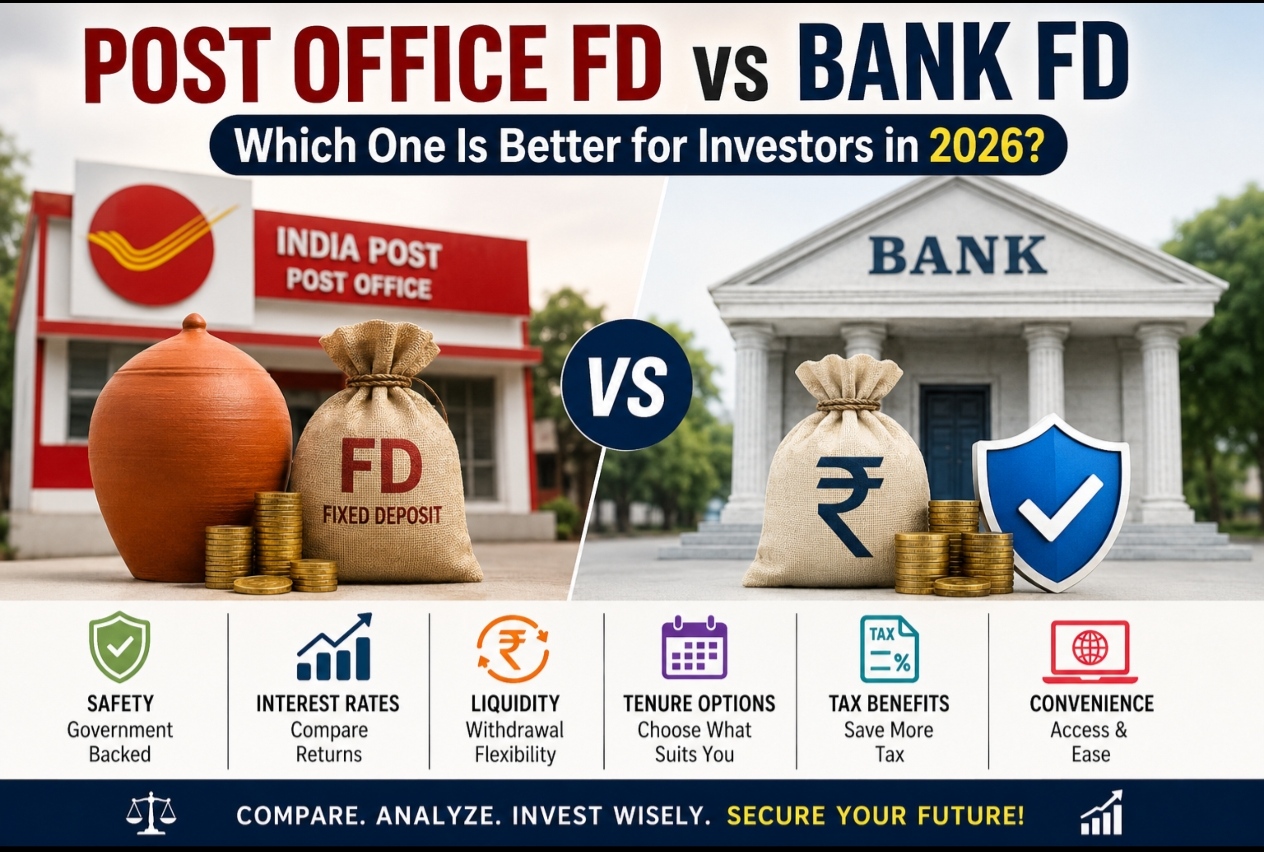
Post Office FD vs Bank FD in 2026: Which One Is Better for Investors?
Fixed Deposit (FD) has always been one of the most trusted investment options for Indian investors. Whether you are a salaried employee, a retiree, or someone looking for a safe place to park your savings, FDs provide stability and guaranteed returns. However, when it comes to choosing between a Post Office Fixed Deposit and a Bank Fixed Deposit, many investors get confused.
Both options offer safety, fixed returns, and peace of mind, but they differ in terms of interest rates, liquidity, convenience, and additional features. In this article, we will compare Post Office FD and Bank FD in detail and help you decide which one is better for your investment goals in 2026.
What is a Post Office FD?
A Post Office Fixed Deposit, also known as the National Savings Time Deposit Account, is a government-backed savings scheme offered by India Post.
Under this scheme, investors can deposit money for a fixed tenure and earn guaranteed interest. Since it is backed by the Government of India, it is considered one of the safest investment options available.
Available Tenures
Post Office FDs are available for:
- 1 Year
- 2 Years
- 3 Years
- 5 Years
The interest rates are reviewed periodically by the government and remain fixed once the deposit is made.
What is a Bank FD?
A Bank Fixed Deposit is a deposit scheme offered by banks where customers invest a lump sum amount for a fixed period and earn interest.
Bank FDs are offered by:
- Public Sector Banks
- Private Banks
- Small Finance Banks
- Cooperative Banks
Banks provide a wide variety of FD products with different tenures and features.
Available Tenures
Most banks offer FDs ranging from:
- 7 Days
- 15 Days
- 1 Month
- 6 Months
- 1 Year
- 5 Years
- Up to 10 Years
This gives investors greater flexibility compared to Post Office FDs.
Post Office FD vs Bank FD: Key Comparison
1. Safety of Investment
Post Office FD
Post Office FDs are backed by the Government of India. This means your investment is fully secure regardless of the amount invested.
Safety Rating: Excellent
Bank FD
Bank FDs are generally safe, especially in public sector and reputed private banks. However, deposits are insured only up to a specified limit under deposit insurance rules.
Safety Rating: Very Good
Winner: Post Office FD
For investors whose top priority is safety, Post Office FD has a slight edge.
2. Interest Rates
Interest rates are one of the most important factors when choosing an FD.
Post Office FD
Interest rates are fixed by the government and revised periodically. They are generally competitive and stable.
Bank FD
Bank FD rates vary from bank to bank.
Many private banks and small finance banks often offer higher interest rates than Post Office FDs, especially for:
- Senior citizens
- Long-term deposits
- Special FD schemes
Winner: Bank FD
If maximizing returns is your goal, some bank FDs can offer better rates.
3. Flexibility
Post Office FD
The scheme offers only four tenure options:
- 1 year
- 2 years
- 3 years
- 5 years
This limits flexibility.
Bank FD
Banks offer a wide range of tenure options from a few days to 10 years.
You can choose a tenure that perfectly matches your financial goals.
Winner: Bank FD
Banks provide significantly greater flexibility.
4. Liquidity and Premature Withdrawal
Post Office FD
Premature withdrawal is allowed but subject to certain conditions and penalties.
The process can also be more time-consuming compared to banks.
Bank FD
Most banks allow easy premature withdrawal through:
- Mobile banking
- Internet banking
- Branch visit
The process is usually quicker and more convenient.
Winner: Bank FD
Bank FDs offer better liquidity and convenience.
5. Loan Against FD
Post Office FD
Loan facilities against Post Office FD are generally limited compared to banks.
Bank FD
Most banks allow customers to:
- Take loans against FD
- Use FD as collateral
- Get overdraft facilities
This can be extremely useful during emergencies.
Winner: Bank FD
Banks provide more financial flexibility.
6. Tax Benefits
Post Office FD
The 5-year Post Office FD qualifies for tax deduction under Section 80C of the Income Tax Act.
Bank FD
Many banks also offer 5-year Tax Saver FDs that qualify for Section 80C benefits.
Winner: Tie
Both options provide similar tax-saving benefits.
7. Ease of Access
Post Office FD
Although digital services have improved, some transactions still require visiting the post office.
Bank FD
Most banks provide:
- Online FD booking
- Mobile banking
- Auto-renewal
- Instant closure
- Digital account management
Winner: Bank FD
The digital experience is usually much better.
8. Senior Citizen Benefits
Post Office FD
Post Office FD offers stable returns but generally does not provide significant additional interest benefits.
Bank FD
Most banks offer extra interest rates for senior citizens, helping them earn higher returns.
Winner: Bank FD
Senior citizens often benefit more from bank FDs.
Advantages of Post Office FD
1. Government Backing
Your money is backed by the Government of India.
2. Guaranteed Returns
Interest remains fixed throughout the tenure.
3. Tax Benefits
5-year deposits qualify for Section 80C deductions.
4. Suitable for Conservative Investors
Ideal for investors who prioritize safety over returns.
Advantages of Bank FD
1. Higher Interest Potential
Some banks offer attractive FD rates.
2. Better Liquidity
Funds can be accessed more easily.
3. Digital Convenience
FDs can be opened and managed online.
4. Multiple Tenure Options
Suitable for both short-term and long-term goals.
5. Loan Facility
Easy access to loans against deposits.
Who Should Choose Post Office FD?
Post Office FD may be the better option if:
- You prioritize maximum safety.
- You are a conservative investor.
- You prefer government-backed schemes.
- You want stable and predictable returns.
- You are investing for long-term capital preservation.
Who Should Choose Bank FD?
Bank FD may be the better choice if:
- You want higher interest rates.
- You need easy access to funds.
- You prefer digital banking.
- You want flexible tenure options.
- You may need a loan against your FD.
Which One Is Better in 2026?
The answer depends on your investment objective.
If your main concern is safety and government backing, Post Office FD is an excellent choice.
However, if you want flexibility, convenience, better liquidity, and potentially higher returns, Bank FD is generally the better option for most investors in 2026.
Many financial experts also recommend diversification. Instead of choosing only one option, investors can divide their savings between Post Office FD and Bank FD to enjoy both security and flexibility.
Final Thoughts
Both Post Office FD and Bank FD remain among the safest investment options available in India in 2026. Post Office FD offers unmatched government-backed security, while Bank FD provides superior convenience, flexibility, and often better returns.
Before investing, compare current interest rates, tenure options, tax implications, and your financial goals. The best investment is not necessarily the one with the highest interest rate—it is the one that aligns with your needs and risk tolerance.
For most investors, a combination of safety, liquidity, and returns should guide the final decision.